For over 20 years, Argentina had the world’s highest number of investor claims before international arbitration tribunals. It also has the highest number of bilateral investment treaties (BITs) in force in Latin America and the Caribbean (LAC). Recently, the government of the self-proclaimed anarcho-capitalist Javier Milei expanded investor rights through the Incentive Regime for Large Investments (RIGI, the Spanish acronym), which grants extraordinary rights to all investors, both foreign and domestic, including the ability to sue the state in international arbitration. The consequences could be a new wave of arbitration claims and increased external debt.
ARGENTINA´S UNIVERSE OF INVESTMENT PROTECTION TREATIES
Argentina is, among all countries across LAC, the country with the most Bilateral Investment Treaties (BITs) in force and ranks among the top 30 worldwide. Most of these were signed during the 1990s (46) under the government of Carlos Menem. These treaties include clauses that grant extraordinary protection to foreign investors, such as National Treatment, Fair and Equitable Treatment, Non-Discriminatory Treatment, and Direct and Indirect Expropriation. These BITs include the investor–state mechanism, which allows claims against the state to be brought before international arbitration tribunals, bypassing national courts. While investors have extraordinary rights under BITs, these treaties do not include any performance requirements for investors; in other words, under the treaties, investors have all the rights, with no obligations, other than those already governed by national laws.
The investor–state arbitration mechanism was used exclusively by foreign investors until the approval of the RIGI in 2024, which extended this privilege to large domestic investors in the energy, mining, and hydrocarbons sectors (among others).
Of the 54 BITs signed, 48 are in force. Treaties with New Zealand (signed in 1999), Greece (1999), the Dominican Republic (2011), Qatar (2016), the United Arab Emirates (UAE) (2018) and Japan (2018) are pending ratification. Of the BITs in force, 41 have reached the end of their original ten-year term, although most are automatically renewed every ten years. This means that the government of Argentina, if it so wished, could terminate 85% of the treaties that enable the ISDS mechanism. Three other treaties, with Portugal, Spain and Switzerland, could be terminated in 2026, which means that the Argentine government could denounce them now to prevent their renewal for another ten to 15 years.
However, no Argentine government since the 1990s has shown any signs of considering this option. Seven BITs were terminated between 2014 and 2024, but four of them (with Bolivia, Ecuador, South Africa, and India) were terminated by the other party. The BIT with Indonesia was terminated by mutual agreement, but at the country’s request, and the treaty with Chile was replaced by a free trade agreement (FTA). The BIT between Argentina and Nicaragua is also listed as terminated, according to UNCTAD, following its expiry.

ARGENTINA – THE WORLD’S MOST SUED COUNTRY
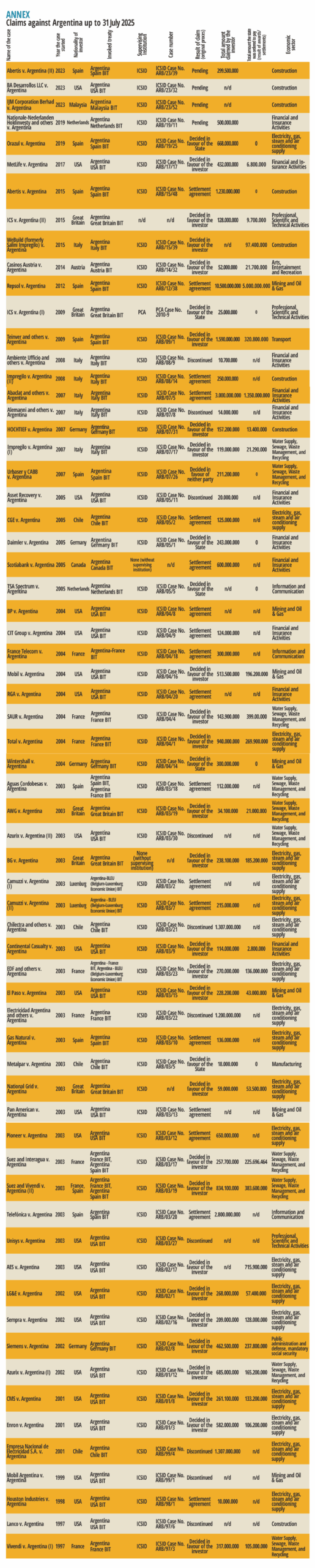
With 65 claims, for over 20 years, Argentina was the world’s most sued country through the ISDS mechanism. In 2025, Venezuela assumed the top place, although just one claim means that Argentina could regain this sad title at any time. Together, Argentina and Venezuela account for almost a third of the known 415 claims against LAC countries as of 1 July 2025.
Most of the lawsuits against Argentina arise from the end of the Convertibility Law in 2002, which included currency devaluation, the freezing of public-service tariffs and the renegotiation of concession contracts. Between 2002 and 2007 alone, Argentina had received a total of 42 claims, peaking in 2003 when 20 of the 25 claims filed against countries throughout LAC were against Argentina. Scholars have referred to this situation as the ‘Argentine case’.

The ICSID – the International Centre for Settlement of Investment Disputes (ICSID) based at the World Bank – is the institution investors most use to resolve claims against Argentina: 94% of the claims against the country were registered with ICSID.
Investors have benefited greatly from claims against Argentina
Of the 65 claims against Argentina, four are still pending, while another 10 have been discontinued. Of the
remaining 51 cases, 26 were decided in favour of the investor, six in favour of the state and 18 ended in an agreement between the parties. One claim was decided in favour of neither party. Given that an agreement between the parties generally benefits the investor in some way, either through payment or the concession of the claim, it can be understood as a favourable decision for the investor. It can therefore be concluded that 86% of the claims already resolved against Argentina (excluding those discontinued) ended with a decision that was beneficial to the investor.

The costs of the claims
The total amount claimed by investors against Argentina, of the 53 of the 65 those where the amount claimed is known, is over US$ 36.8 billion. Of the four pending claims, the compensation claimed just by two of the investors amounts to almost US$ 800 million.
Argentina was ordered to pay (or agreed to pay) US$ 10 billion. This includes the awards of the arbitration tribunals where Argentina lost, plus the amount of three of the 18 claims that were settled by mutual agreement, as no information is available on what Argentina conceded in the other agreements.


Investors suing Argentina are US-American and European
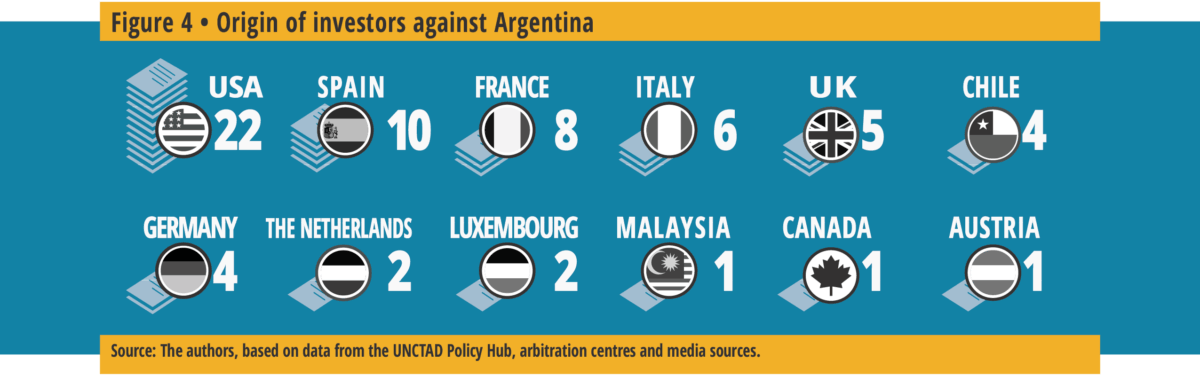
A third (22) of all claims against Argentina are from US-American investors, followed by (10), France (8) and Italy (6). Thus, total claims from European investors account for 57.6% of the cases against Argentina and, together with investors from the US and Canada, they exceed 92%. The only LAC country whose investors have sued Argentina is Chile, with four lawsuits.
Sectors in which claims are registered
Claims against Argentina are from a wide range of sectors, although most are in the service sector, mainly
energy supply (19 claims), financial activities (11 claims) and water supply and waste management (10). In total, these account for 61.5% of all claims against Argentina.


THE RIGI AND THE EXPANSION OF RIGHTS FOR INVESTORS
The Incentive Regime for Large Investments (RIGI) is part of the Basic Law (Law 27,742), promoted by the Milei government in 2024. It came into force on 23 August 2025. This regime seeks to attract foreign and domestic investment of more than US$ 200 million in sectors such as mining, energy, oil and gas, forestry, tourism, infrastructure, technology and steel.
The RIGI can be understood as a BIT-Plus because it significantly expands investors’ rights. It guarantees
regulatory stability for 30 years in tax, customs, and exchange matters, protecting participating companies
from any future legislative changes that may be more burdensome or restrictive. This regulatory framework conditions the Argentine state’s policy for 30 years, limiting its ability to capture extraordinary rents from key sectors such as mining and oil and to develop productive development policies.
The RIGI also grants the ISDS mechanism to domestic investors, which is a new feature compared to existing BITs. This means that domestic investors will also be able to bypass the Argentine judicial system and resort directly to international arbitration in disputes with the national government.
‘The RIGI represents an unforgivable legislative delegation of powers in the area of hydrocarbon environmental management, the granting of tax and exchange privileges to extractive industries, without any social or environmental considerations, and the limitation of opportunities for public participation.’
Letter sent to the Argentine Senate in May 2024 by FARN, CELS and Argentine social organisations.
In its first year of existence, several companies have announced or requested to join the RIGI. Several have used the ISDS mechanism against states in other parts of the world, such as Rio Tinto, First Quantum, Zijin, Ganfeng, Chevron and Shell or even against Argentina itself, such as Pan American Energy (PAE). This highlights the danger of a new wave of lawsuits that Argentina could face in the event of regulatory changes that may be driven by economic, social or political crises in the near future.
27 YEARS OF ISDS LAWSUITS – EMBLEMATIC EXAMPLES OF CASES AGAINST ARGENTINA
ABACLAT VS. ARGENTINA
How 180,000 bondholders became protected investors thanks to ICSID.
In 2006, 180,000 Italian shareholders represented by the Association for the Protection of Investors in Argentine Securities (known as Task Force Argentina (TFA), made up of eight Italian banks) sued Argentina before ICSID. They demanded payment of bonds acquired in the 1990s, which had been suspended after Argentina defaulted on its payments following the 2001 crisis. These were investors who did not accept the debt-swap plan presented by the Argentine government in 2005.
Of the 180,000 Italian creditors, between 2005 and 2010, 120,000 accepted the government’s swap offer. However, the claim of the remaining 60,000 bondholders remained pending until 2016, when the government of Mauricio Macri agreed to pay the sum of US$ 1.35 billion to the TFA, which then distributed the amount among its 60,000 remaining clients. This sum was equivalent to 150% of the bondholders’ initial investment and included part of the TFA’s legal and administrative costs. In addition, Argentina had spent US$ 12.4 million on its defence up to 2011.
FIGURES IN THE ABACLAT V. ARGENTINA CASE:
» In 2006,180.000 bondholders filed the lawsuit
» 120.000 acepted the Argentine government’s offers (2005–2010)
» 60.000 remained in the lawsuit until the end
» But these 60.000 received US$ 1.35 billion in 2016
» 150% of the initial investment: Not only did they recover what they lost, but they also gained an 50% extra
The case shows that:
What constitutes an ‘investment’ is solely up to the arbitration court.
In fact, the claim was full of irregularities. The bonds bought by Italian shareholders were placed by various investment banks acting as administrators, such as BNP Paribas, Deutsche Bank, J.P. Morgan, and Morgan Stanley. Through these banks, the vast majority of Italian bondholders had acquired security entitlements on secondary markets; in other words, they never carried out any transaction or ‘investment’ in Argentina, but rather with a financial institution outside its territory. Nevertheless, the majority of the tribunal decided that this was also a case of ‘protected investments’ under the BIT between Argentina and Italy and therefore an admissible claim before ICSID. This decision sets a precedent in the history of ICSID and encourages shareholders who have obtained financial instruments from states to follow the same path.
Arbitration tribunals are placed above national laws. This is the first claim that has functioned as a class action before ICSID. However, the BIT between Argentina and Italy does not provide for the protection of investments in the event of a class action. Furthermore, Argentina did not give its consent to this. Nevertheless, the arbitration tribunal ruled that any BIT implied consent to a class action, thus dismissing Argentine law.
VIVENDI II VS. ARGENTINA
Investors and arbitration tribunals together against human rights.
At the end of 2001, Argentina entered the worst economic, social, and political crisis in its history. In January 2002, through the Economic Emergency Law, the government devalued the peso and froze utilities’ rates such as water, gas and electricity to mitigate popular unrest. In 2003, in response to the government’s refusal to raise water rates, the French companies Suez and Vivendi and the Spanish company Aguas Barcelona filed a US$ 834 million lawsuit before ICSID, known as Vivendi vs. Argentina II.
These companies had obtained concessions for the water system in Greater Buenos Aires in 1993 by purchasing shares in the company Aguas Argentinas SA. At the time it was awarded, it was the world’s largest concession, with a population of 7 million, which rose to 12 million in 2006.
In 2015, the ICSID tribunal awarded the companies US$ 383.6 million in its final award, of which US$ 223 million went to Suez, US$ 123.2 million to Aguas de Barcelona and US$ 37.5 million to Vivendi. In January 2018, the government of Mauricio Macri agreed with the companies to pay US$ 257 million of this award. In total, there are some nine lawsuits related to the sanitation and water-distribution sector that arose in the wake of the 2001 crisis, three of which involve the French company Suez. Most of these lawsuits were decided in favour of the investor and require the Argentine state to pay more than US$ 850 million to companies that took advantage of the country’s crisis for their own enrichment.
The case shows that:
Arbitration tribunals give primacy to investment protection over human rights. In 2006, the
Argentine state terminated the concession contract and nationalised Aguas Argentinas SA because foreign companies had violated the human right to access to drinking water. The companies had prioritised their economic interests, providing better services in profitable areas of the concession while leaving the poorest sectors of the population without drinking water. Due to a lack of maintenance and investment, the concession companies had distributed well water contaminated with nitrates, endangering the health of more than 800,000 people in the Buenos Aires districts of La Matanza, Lomas de Zamora, Quilmes and Almirante Brown. Despite the seriousness of the allegations, the arbitration tribunal rejected the state’s arguments and ruled that Argentina must respect its international obligations under investment treaties as well as human rights. According to the tribunal, the two are ‘neither mutually inconsistent, nor contradictory, nor exclusive’.
The scandalous conflict of interest of the arbitrators. The Swiss arbitrator Gabrielle Kaufmann-
Kohler, appointed by the companies, was appointed director of the UBS group in April 2006. This company was, in turn, a shareholder in Vivendi and Suez. Consequently, Kaufmann-Kohler stood to benefit indirectly from an award in favour of the investors, in this case as director of a shareholder of the companies bringing the action. However, in May 2008, the court rejected her challenge, stating that the relationship between the arbitrator and the claimants was not sufficiently direct to cast doubt on her independence and explained that ‘arbitrators are not disembodied spirits living on Mars who descend to earth to arbitrate a case and then immediately return to their Martian retreat, where they wait motionless until the next call to arbitrate. Like other professionals living and working in the world, arbitrators have a variety of complex connections with people and institutions of all kinds’.
METLIFE VS. ARGENTINA
Corporations against the right to a decent retirement.
In 1994, after controversial debates and strong opposition from trade unions and the opposition, a private pension system was introduced in Argentina. The privatisation of the Argentine pension system was further accelerated by an agreement with the IMF. All workers’ contributions were integrated into the Pension Fund Administration Agency (AFJP) without the possibility of later returning to the state system (only with express notification to remain in the public system).
At the same time, the state promised to guarantee a Universal Basic Benefit and to be the ultimate guarantor of pension funds and benefits, while almost all pension contributions ended up in private companies grouped under the umbrella of the AFJP. The public pension system, which was already experiencing serious financing problems, was dismantled and defunded. What happened over the next 15 years was the nationalisation of costs and the privatisation of benefits: in less than ten years, the annual deficit from pension privatisation rose from 1% to 3% of gross domestic product (GDP), while administrative costs increased exponentially and the number of people covered by the system fell steadily. In 2008, the Argentine Congress decided to return to a public social security system, dissolving the AFJP and returning the pension funds collected to the state coffers.
Almost ten years later, the US insurance company Metlife sued the Argentine government before ICSID for its decision to end the pension fund management business, claiming US$ 432 million in compensation. In 2024, the arbitration tribunal ruled in favour of Metlife, ordering Argentina to pay more than US$ 8 million (including interest) to Metlife for the expropriation of its business.
THE CENTRAL PARADOX
MetLife claimed compensation for losing the right to manage funds that never belonged to it: the pension contributions of Argentine workers. It is as if a bank sued the state to recover its customers’ deposits.
The case shows:
The pro-investor bias of arbitration tribunals. Although the arbitration tribunal stated in its award
that there was no arbitrariness in the Argentine government’s decision to renationalise the pension system, it decided that the termination of the business constituted a clear case of ‘direct expropriation’. It did not matter that the Argentine private pension system, in which MetLife had been the second-largest provider, was completely dysfunctional. The award did not consider it relevant that for 15 years MetLife increased its profits with the money of Argentine workers by keeping contributions high, even though its administrative costs were significantly reduced. Nor did it matter that Argentina argued that MetLife could have offered other insurance services in Argentina because, according to the arbitrators, ‘it lost the only business that, at that time, it was legally permitted to carry out and that generated a constant and predictable income stream’
The arbitration tribunals’ disregard for human rights. In 2021, seven human rights organisations
filed an amicus curiae brief arguing that human rights should take precedence over economic interests. In their justification, they use the same BIT between the US and Argentina invoked by the investor.
‘Argentina and the United States agreed that their objective of promoting trade and investment between them shall not be to the detriment of their prior obligations under international law, such as human rights commitments. According to the text, the interpretation and application of the Bilateral Investment Treaty (BIT) requires adequate consideration of international human rights law.’
Amicus curiae brief by seven human rights organisations in Argentina, March 2021.
However, according to media sources (since the final ruling was not published), the organisations’ assessment was not part of the final considerations or the ruling. In fact, neither the company’s performance in Argentina nor the relevance of the Argentine government’s decision to protect the human rights of the elderly were part of the arbitration decision. Nor was an open letter published in 2021 by Nobel Prize-winning economist Joseph Stiglitz and more than 100 specialists in international economics, development policy and social security relevant. In it, they condemn MetLife (and others) for their decision to sue Argentina (and Bolivia).
‘Pension systems exist to provide income security in old age, to ensure that older people retire with adequate pensions. It is the duty of the governments of Argentina and Bolivia to ensure the well-being of their citizens.’
Quote from the open letter by J. Stiglitz et al., 2021.
The domino effect of the ISDS system. Following their example, in 2018 Banco Bilbao Vizcaya Argentaria (BBVA) and, in 2020, Zurich Insurance sued Bolivia for its decision to end the privatisation of its pension system, implemented in 2009. While Zurich’s lawsuit is still pending, the ICSID tribunal ruled in favour of BBVA, awarding it nearly US$ 95 million. In addition, in 2019, Nationale-Nederlanden Holdinvest sued Argentina for returning to the public pension system, claiming US$ 500 million. This lawsuit is still pending. Finally, in 2021, MetLife again threatened to use the ISDS mechanism, this time against Chile, which had passed Law 21.330, which includes the right of pensioners to request advance payments of life annuities. In fact, it was not the only insurer to issue such threats. Zurich Insurance was also among the companies. These lawsuits have not yet been filed, but they show that companies that were once successful in the system are once again resorting to this exclusive legal avenue.
ABERTIS VS. ARGENTINA
The corporate hijacking of motorways.
In December 2015, the Spanish corporation Abertis67 (owned by Italy’s Mundys, Germany’s Hochtief and Spain’s ACS) filed an arbitration claim against Argentina before ICSID.68 The claim stemmed from the freezing of toll rates on two main access roads to Buenos Aires: the Panamericana (Autopistas del Sol) and the Acceso Oeste. In 2003, following the currency crisis, the government of Néstor Kirchner decided to freeze toll rates on these (and other) motorways to mitigate the effects of the economic crisis.
Abertis claimed to have lost US$ 3 billion as a result of this measure and demanded more than US$ 1 billion in compensation. In 2018, Abertis and the then government of Mauricio Macri reached an agreement. The Argentine government recognised a debt of US$ 800 million, which with interest amounted to more than US$ 1 billion and allowed it to collect that debt through continuous increases (even above inflation rate) in toll rates. It also extended the concession until 2030. As a result, the lawsuit was discontinued in July 2018.
’When 2015 came around, the companies filed a claim with the World Bank against the Argentine government for millions of dollars that were unpayable. What they did was negotiate with the government to prevent the lawsuit from moving forward. Two years later, when Macri had already doubled tolls twice and sold the shares at four times their value, Guillermo Dietrich (Minister of Transport) signed an extension until 2030.’
Alejandro Bercovich, journalist and researcher.
Just five years later, the company filed a new lawsuit with ICSID, after Alberto Fernández’s government declared, through an audit, that the concession contract renegotiated in 2018 was ‘detrimental to the general interest’ and ordered that the necessary legal steps be taken to declare the contract null and void. According to media sources, Abertis is claiming nearly US$ 300 million in compensation. The lawsuit is still pending.
Abertis’ lawsuits show that companies use the system to twist the arm of governments, obtain concessions, and increase their profits. Investors use ISDS lawsuits for different purposes. In the first phase, when they threaten to sue, or send official notification, but without registering the lawsuit, they try to reverse the government decision that allegedly affected their business. If they fail to get the government to back down, they then file the claim to increase the pressure. In most cases, however, negotiations continue to assess whether an agreement can be reached. This is what happened in Abertis’ first claim against Argentina. In this case, it was facilitated by the pro-investment government of Mauricio Macri, whose company, Grupo Macri, had been a partner of the motorway concessionaire until 2017 alongside Abertis. In other words, Macri arranged an agreement between parties with his former partners from which they benefited greatly, using the arbitration system as leverage.
Finally, if the two previous options do not work out for investors, they seek to obtain a favourable award and multimillion-dollar compensation. We do not yet know whether this latest lawsuit will result in an award or, once again, in an agreement between the parties. Media sources report that Javier Milei attempted to resolve the dispute when he took office in 2023. In the meantime, the lawsuit continues at ICSID.
REPSOL VS. ARGENTINA
When public assets become private plunder.
In 1999, Repsol, a relatively small Spanish oil company, bought the entire Yacimientos Petrolíferos Fiscales (YPF) in Argentina. In 2012, the state expropriated Repsol’s shares on the grounds that the country’s energy selfsufficiency had to be guaranteed. The company responded by filing lawsuits in four courts, including ICSID. Although its claim was for US$ 10.4 billion, the government threatened to investigate environmental liabilities. Finally, in 2014, an agreement was reached for US$ 5 billion to settle the case.
Despite this, a decade later, the country faced a new setback in the same case, following a lawsuit filed in New York by the hedge fund Burford, which acquired the right to litigate from a minority partner at the time of the expropriation: the Argentine group Petersen. By updating the value of its claim, Burford would obtain some US$ 16 billion.
The YPF case shows how different actors – from Spain’s Repsol to Argentina’s Petersen Group and
finally the speculative fund Burford – employed similar strategies of appropriation: they used YPF’s own assets to finance their purchase, extracted massive dividends, sold off company assets, and then walked away with million-dollar lawsuits. These processes not only represent a transfer of wealth from the state to private capital, but also weaken YPF’s ability to meet national development, energy sovereignty and social-distribution objectives.
CONCLUSIONS: ARGENTINA AT A CROSSROADS
With 65 ISDS claims and 48 BITs in force, most of which were signed during the 1990s, Argentina is an example of how structural adjustment and economic liberalisation policies were accompanied by legal frameworks that perpetuate corporate privileges and stifle state regulatory action. In this sense, the recent RIGI does not represent a break with the past, but rather a radicalisation of corporate logic. This measure deepens the extractivist model and definitively subordinates public policies to the imperatives of corporate profit.
The US$ 10 billion that Argentina has paid or agreed to pay in ISDS claims is equivalent to the primary deficit for 2024 and twice the annual education budget. This massive transfer of public resources to TNCs shows how the ISDS system operates as a mechanism for extraordinary corporate profits, emptying state coffers and limiting the state’s ability to guarantee fundamental social rights.
Argentina could unilaterally terminate more than 85% of its BITs whose initial period has already expired or expires in 2025 (before being renewed). However, no government since the 1990s has seriously considered this option, demonstrating how local elites have internalised the imperatives of transnational capital. President Javier Milei’s RIGI seeks to close this window once and for all, consolidating a legal framework that shields corporate privileges for 30 years.
RECOMMENDATIONS FOR A FUTURE WITHOUT ISDS
1 • Do not sign new treaties with investment protection clause.
2 • Terminate existing BITs containing the ISDS mechanism.
3 • Withdraw from ICSID and promote the use of domestic justice for the resolution of disputes between investors and states.
4 • Repeal Argentina’s Incentive Regime for Large Investments (RIGI).
5 • Conduct a comprehensive citizen audit of all investment protection treaties and their economic, social, and environmental impacts. Suspend the possibility for investors to use the ISDS mechanism for the duration of the audit and take the necessary steps once it is completed.